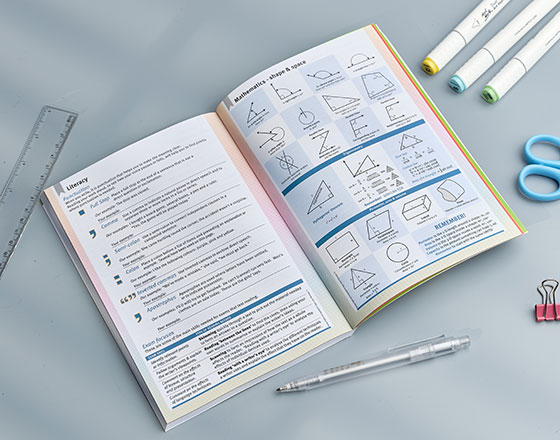
Knowledge organisers have become a staple in classrooms and for good reason. When used well, they help students retain essential information, support revision and give teachers a clear framework for what needs to be taught. But handing out a sheet of key facts is only the starting point -the real impact comes from how knowledge organisers are used, both in lessons and at home.
Below, we explore what knowledge organisers are, why they work, what to include on them and, most importantly, how to use them effectively to boost long-term retention and revision.
What Is a Knowledge Organiser?
A knowledge organiser is a single-page document that sets out the most important knowledge students need to learn for a given topic or unit of work. Typically presented on one side of A4, it distils key vocabulary, dates, people, concepts and facts into an accessible, easy-to-reference format.
The single-page layout is deliberate. It forces teachers to think carefully about what truly matters within a topic, separating essential knowledge from supplementary detail. This clarity benefits everyone involved. Teachers gain a sharper sense of curriculum intent, students know exactly what they are expected to learn and parents can see at a glance what is being covered in class.
It is worth noting what a knowledge organiser is not. It is not a replacement for expert teaching, nor is it a comprehensive revision guide. Think of it as a foundational tool — one that supports the curriculum rather than defining it.
Why Are Knowledge Organisers So Effective?
The effectiveness of knowledge organisers is rooted in well-established principles from cognitive science. Here are the key reasons they work so well when used properly.
They Support Long-Term Memory
Our working memory can only handle a limited amount of information at any one time. For students to succeed with more complex tasks (writing an essay, solving a multi-step maths problem or analysing a source in history) they need a solid bank of factual knowledge stored in their long-term memory. Knowledge organisers provide the foundation for building that bank. When key facts are committed to long-term memory, working memory is freed up to focus on higher-order thinking.
They Create Opportunities for Retrieval Practice
Research shows that actively recalling information strengthens memory far more effectively than simply re-reading it. Knowledge organisers lend themselves perfectly to retrieval practice. Students can cover the organiser and attempt to write down everything they remember, answer quiz questions drawn from it or fill in a blank version. Each act of retrieval strengthens the memory trace and reduces the rate of forgetting.
They Promote Inclusion and Accessibility
For students who find it harder to keep up, knowledge organisers offer a clear, structured reference point. They can be used by teaching assistants to support targeted intervention, or by students independently to fill gaps in their understanding. Because the key facts are laid out plainly, students can take ownership of their own learning and work on areas where they need the most practice.
What Should a Knowledge Organiser Include?
The contents will vary depending on the subject and year group, but certain elements appear consistently across effective knowledge organisers:
- Key vocabulary and definitions — Clear, child-friendly definitions of the essential terms students need to understand and use correctly throughout the topic.
- Key facts and concepts — The foundational knowledge that underpins the unit, such as important dates in history, scientific principles or mathematical properties.
- Key people and places — Where relevant, the significant figures or locations students should know and be able to reference.
- Useful diagrams or visuals — Simple images, timelines or diagrams that help illustrate relationships between ideas or make abstract concepts more concrete.
- Important quotes or stem sentences — Particularly useful in English and maths, these give students language they can draw on in their own work.
How information is organised on the page matters too. Grouping related facts together, using clear headings and leaving enough white space for readability all make the organiser more effective as a learning tool.
How Should You Use Knowledge Organisers in the Classroom?
A knowledge organiser will not lead to improved retention on its own. The way it is woven into teaching practice makes all the difference.
Introduce It Before the Topic Begins
Giving students access to the knowledge organiser before teaching starts allows them to build some prior knowledge. Students who already have a basic familiarity with key terms and concepts are better placed to engage with new material, because new knowledge has something to attach itself to. Sending a copy home a week before a new topic begins can be particularly effective.
Use Regular Low-Stakes Quizzing
Frequent, short quizzes drawn from the knowledge organiser are one of the most impactful strategies you can adopt. Five questions at the start of a lesson, taking no more than five to seven minutes, can significantly boost retention over time. Keep conditions low-pressure — use the term “quiz” rather than “test,” avoid public scoring and focus on the process of strengthening memory rather than formal assessment.
Build Cumulative Quizzes Over Time
Rather than only testing the most recent section, include questions from earlier parts of the knowledge organiser. This interleaving ensures students revisit and retain knowledge from across the whole topic, not just the material covered that week.
Ask Elaborative Questions
Go beyond simple recall by asking students to explain why something is important or how one concept relates to another. This kind of elaborative interrogation deepens understanding and helps students build more complex mental frameworks, connecting different pieces of knowledge together.
Display and Reference It Regularly
Keep an enlarged version visible on a working wall and encourage students to refer to it during lessons. Use it as a spelling and vocabulary reference and expect students to use the correct terminology in their written and spoken work.
How Can Students Use Knowledge Organisers at Home?
For knowledge organisers to reach their full potential, students need to use them independently outside the classroom. However, this will not happen without clear guidance.
Teach the “Look, Cover, Write, Check” Approach
Students should study a section of the organiser, then put it away and write down everything they can remember on a blank piece of paper. Comparing their attempt against the original reveals gaps and focuses future study. This is far more effective than passively re-reading, which creates a false sense of familiarity without truly embedding knowledge.
Encourage Family Involvement
Knowledge organisers give parents and carers a simple, accessible way to support learning at home. A family member can quiz a student using the organiser, turning revision into a quick, manageable activity rather than something that feels overwhelming.
Chunk the Learning
Rather than trying to learn the entire organiser at once, students should focus on small sections at a time. Setting specific sections as homework each week, then gradually building up to cumulative recall, mirrors the spaced practice approach and leads to much stronger retention.
Supporting Retention and Organisation With Penstripe
Knowledge organisers are a powerful tool, but their impact depends on quality, clarity and alignment with your school’s curriculum. That’s where Penstripe can help.
We work with schools, trusts and colleges to create 100% bespoke knowledge organisers, designed from cover to cover to match your unique curriculum. From maths formulas and historical timelines to science concepts and language structures, every page is tailored to support your students’ learning.
Every knowledge organiser we produce features full colour throughout, printed on high-quality paper to ensure vibrant, clear results on every page. We also offer three durable binding options to suit your needs:
- Square Back Binding – Our most popular option, allowing up to 200 pages in a lay-flat format that makes every page easy to use.
- Wiro Binding – A great choice for knowledge organisers with fewer pages.
- Perfect Binding – The premium option for schools seeking the highest-quality finish.
All options are available in A4 or A5 sizes. With over 30 years of experience, a dedicated UK-based team and our delivery on-time guarantee, we make the process simple from quote through design to delivery. Our team will collaborate with you to integrate your designs into our templates, ensuring every page is produced exactly as you envision.
Explore our range of knowledge organisers, or contact our friendly team today.