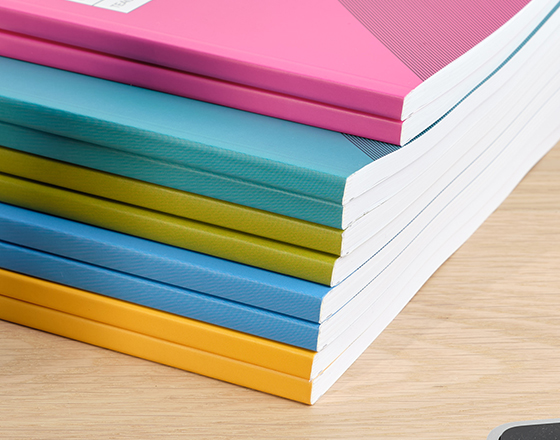
The short answer is that no single exercise book suits every subject, so the sensible approach is to match the ruling, paper weight, size and format to how each subject is actually taught. Maths needs squares for aligning calculations and plotting graphs, English needs lined pages at a width that fits the age group, science has to cope with both diagrams and results tables, and art asks for heavier paper that can take paint without bleeding through. Choosing one book for the whole timetable usually means every subject settles for a compromise.
Working through the timetable subject by subject takes a little more thought at the ordering stage, but it pays off in neater work, fewer wasted pages and books that hold up to the way they are used. However, the bigger gains come from personalising the book to the subject, from a simple branded cover through to a workbook that carries the course content itself.
Below, we go through the main subject groups and the specification that tends to serve each one best.
Why does the subject change which exercise book works best?
A subject makes demands on the page, and those demands are not the same from one room to the next. A maths lesson asks students to line up digits, draw axes and keep working legible, which a grid supports and a blank or widely lined page does not. An English lesson is mostly continuous writing, where lines at the right spacing guide handwriting and give a teacher somewhere to mark. Science swings between labelled diagrams, which suit open space, and plotted results, which need a grid. Art wants room and a surface that will not buckle under wet media.
Paper weight matters for the same reason. A light 75gsm page is fine for pencil and ballpoint across most written subjects and keeps the cost sensible when you are ordering in volume. A page that has to carry marker pen, heavy shading or paint needs more substance, or the work shows through and the reverse becomes unusable. The mechanics of paper weight, line spacing and binding are worth understanding on their own, and we set them out in a separate guide to exercise book specifications. This article takes those building blocks and applies them subject by subject.
Which exercise book suits maths?
Maths is the clearest case for a squared page. The grid lets students align units, tens and hundreds in column arithmetic, keep long division tidy, plot coordinates accurately and draw bar charts and graphs to scale. On plain or lined paper those same tasks drift out of line, and a misread column becomes a wrong answer that has nothing to do with the maths.
Square size should follow the age group. Larger squares around 10mm suit Key Stage 2, where the work is column methods, simple tables and early data handling. Smaller 5mm or 7mm squares are the usual choice for Key Stage 3 and Key Stage 4, where graphs get more detailed and students need to fit more working onto a page. A margin is still useful on a squared book, since it gives the teacher a consistent place to mark and keeps the first column clear of the spine.
What ruling works best for English and languages?
English and modern foreign languages are built on continuous writing, so a lined page is the natural fit. The decision that matters is line spacing, and it tracks the age and handwriting stage of the students rather than the subject label. Wider lines of 10mm to 15mm support younger writers who are still forming letters and building stamina. The standard 8mm line suits upper Key Stage 2 upwards, where the task is extended writing and exam-style responses and students can write smaller without losing legibility.
Languages carry one extra consideration. Students writing in French, Spanish or German are adding accents above and below letters, so a clear line spacing helps keep those marks readable rather than crowding them into the line above. A margin earns its place here too, giving teachers room for corrections and feedback on a subject where accuracy of spelling and accent is part of the assessment.
How should science exercise books handle diagrams and graphs?
Science is the subject that pulls in two directions at once. A single lesson might ask for a labelled diagram of a cell, a results table and a line graph, and those jobs do not all want the same page. Labelled diagrams sit more comfortably on plain or lightly gridded paper, where nothing interrupts the drawing, while graphs need a grid so students can plot points and read off values accurately.
Two approaches work in practice. Some schools run a square or graph-ruled book for science so that plotting is always straightforward and accept that diagrams sit on the grid. Others use a lined book and have students stick in graph paper for the occasional plotted result. Practical work is also harder on the page than note-taking, since books pick up smudges, damp and the odd spill at the bench, so a slightly heavier paper weight holds up better across a year of experiments than the lightest stock does.
What do art, design and technology need from the page?
Art and design and technology are where paper weight stops being a detail and starts being the whole point. Pencil sketching, ink, paint, marker and glued-in work all punish a thin page, which cockles when it gets wet and lets colour bleed through to the next sheet. A heavier cartridge paper, in the region of 100gsm to 140gsm, takes wet and dry media far better and gives the book a more substantial feel that suits the work.
Format matters as much as weight. Plain pages give students the open space to draw, design and annotate without a grid or lines getting in the way, and a larger size, whether a generous A4 or a step up to A3, gives bigger pieces somewhere to live. For sketchbook-style work, a plain book on heavier stock effectively becomes the sketchbook, which keeps a class working to one consistent format rather than a drawer of mismatched pads.
Which books help younger primary pupils with handwriting?
Early primary is a subject group in its own right as far as the page is concerned, because the main task is learning to write at all. Wide lines of 12mm to 15mm give Early Years and Key Stage 1 children the space to form letters at the size they can actually manage, and handwriting guidelines, with a dotted or dashed centre line, give them a reference for letter height and shape as cursive is introduced.
Combination rulings suit this stage especially well. A page that is half plain and half lined lets a child write a sentence and draw the picture to go with it, which is how a great deal of early literacy is taught. Keeping these formats consistent across a year group matters more than it might seem, since children build stronger habits when every book they open behaves the same way.
Do humanities and essay subjects need anything different?
History, geography, religious education and similar essay-led subjects are mostly continuous prose, so an 8mm lined book with a margin covers the bulk of the work. The margin is doing real work here rather than decorating the page. It gives the teacher a clear column for feedback, codes and literacy marks, which is exactly where a marking policy expects comments to sit.
Geography is the one to watch, since it can tip into map work, sketch maps and data handling that a plain or squared insert supports better than lines do. For most of these subjects, though, the sensible default is a good lined book with a margin, and the real decisions are about paper weight and page count rather than the ruling itself.
What about music and other specialist subjects?
Music is the subject that stock exercise books rarely cater for. Writing music needs paper where the page is ruled into staves of five lines each so students can place notes at the right pitch. Many schools run a dedicated staved book for music alongside a normal lined book for written theory, listening notes and keyword work, which keeps the notation clean without forcing every written task onto manuscript paper.
Other specialist needs come up across the timetable, and they are worth specifying rather than working around. For example, a dot lattice, or dotted grid, gives a lighter guide than full squares and suits design work, graphics and some approaches to note-taking.
How much should you personalise each subject’s book?
The books are made to order rather than pulled off a shelf, so you can personalise each subject’s book as much or as little as the subject needs. That is where a bespoke book starts to do far more than a generic one ever could.
Personalise the cover: the school name and logo, a subject colour that makes a maths book easy to tell from an English one at a glance, and space for a pupil’s details on the front. That alone helps with identification, presentation and the sense that the book belongs to the school.
Also, knowledge organisers, worked examples, retrieval and practice tasks can all be printed into the book itself, so the material a department would otherwise print, collate and hand out as loose worksheets is bound in from the start.
That saves staff time and photocopying cost across a year, keeps every pupil working from the same materials, and supports consistent delivery of the curriculum in a way a generic book cannot.
A quick reference by subject
The table below sums up the starting point for each subject group. Treat it as a sensible default rather than a rule, since a school’s own teaching methods and marking policy should have the final say.
| Subject | Typical ruling | Paper and format notes |
| Maths | Squared, 10mm for KS2, 5mm to 7mm for KS3 and KS4 | Margin for marking; grid supports graphs and column methods |
| English and languages | Lined, width by key stage | 8mm from upper KS2; margin for corrections and feedback |
| Science | Squared or graph, or lined with graph paper added | Slightly heavier paper stands up to practical work |
| Art and design technology | Plain | 100gsm to 140gsm cartridge; larger A4 or A3 format |
| Early primary | Wide lined, handwriting guides, combination | 12mm to 15mm lines; half-plain half-lined for write and draw |
| Humanities and essay subjects | Lined, 8mm with margin | Plain or squared inserts for map and data work |
| Music and specialist subjects | Manuscript staves for music; dot lattice for specialist work | Bespoke rulings for formats stock ranges do not carry |
Matching every book to the subject it serves
Buying the right book for each subject only works if the books can actually be made that way, and this is where bespoke production earns its place. At Penstripe we build exercise books to each school’s own specification, which means the ruling, paper weight, size and cover can differ from one subject to the next rather than bending every subject to a single stock book. Books are available in A4, A5 and other sizes, with coloured paper options that help support SEND students, and every book can be set up by subject, year group or form group with your school branding.
Backed by more than 30 years of expertise and a UK-based team, we take a school through the process from quote to design to delivery, so matching a book to each subject is a conversation rather than a compromise. If you want to work out the right specification for each subject on your timetable, you can build the whole set from one bespoke range of exercise books, or call 0113 231 0995 or email info@penstripe.co.uk to talk it through with the team.